Authorisation letter form: let someone act on your behalf
Sometimes you cannot be there in person. This form produces an authorisation letter: the person giving the authorisation enters their name and address, then the name and ID or passport number of the person who may act for them, what they are authorised to do, how long it is valid, the date and a signature.
Who it is for
- People who need someone to collect a parcel, a document or keys
- Landlords, tenants and families handling errands for each other
- Small organisations that want a standard letter for staff or members
When to use it
Use it whenever a third party needs a written note, for example to pick up a package or to deal with an office. Stating what exactly is allowed, and until when, keeps the authorisation narrow and clear.
What the form asks
The person authorising
- Full name · requiredShort text
- Address · requiredShort text
The person authorised
- Full name · requiredShort text
- ID or passport numberShort text
- What are they authorised to do? · requiredLong text
- Valid untilDate
- Date · requiredDate
- Signature · requiredSignature
Every question can be changed, removed or reordered before you publish.
The PDF your respondents receive
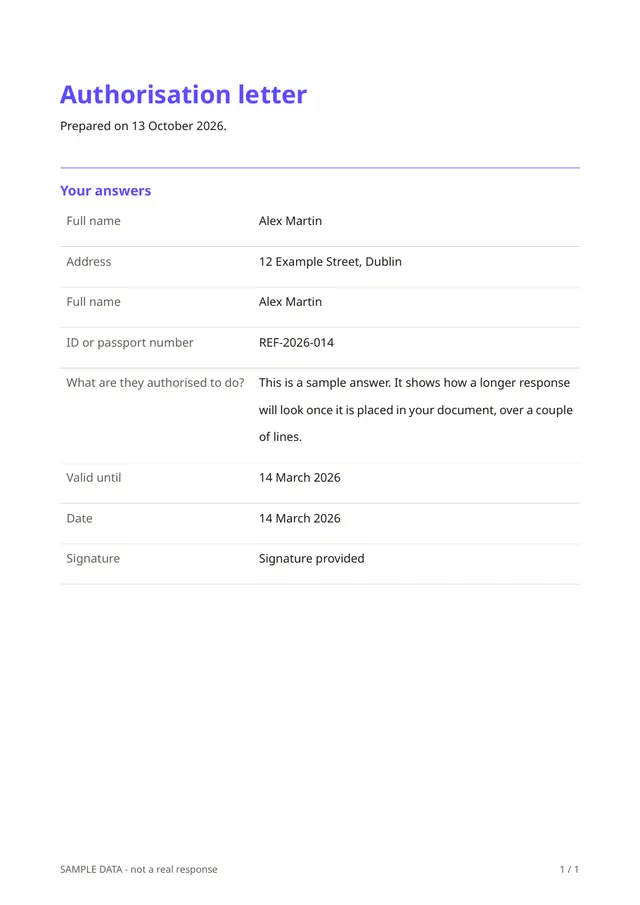
The PDF reads as a ready-to-print letter with the names, the scope, the dates and the signature. The person acting can carry it with their ID.
Questions people ask
- Will every office accept it?
- Not necessarily. Banks, government offices and some companies require their own forms or a notarised document. Check with the organisation first.
- Does the other person have to sign too?
- Not in this template. Add a second signature question if your situation calls for it.
- Should I include the ID number?
- Only if the organisation needs it. Sharing an ID number is sensitive, so the question is optional.
Start from this template
Create an account, adapt the questions and the document to your business, then share the link. Your respondents get their PDF the moment they finish.