Inspection report template: what to record, with photos and a signature
Updated 21 October 2026 · 7 min read
An inspection report records who inspected what, where and when, the condition of each area, what needs attention, photos and a signature. Keep it short and consistent: the same headings on every visit make it easy to compare one inspection with the next.
An inspection report is the record of one visit: who looked at what, where, when, what they found and what should happen next. Landlords and letting agents use them for routine checks during a tenancy and at the end of it. Contractors, facilities managers and safety officers use them on sites. The details differ, but a good inspection report template has the same backbone. This guide covers what to include, the notice rules for rental property in the UK and Ireland, and how to fill one in on a phone.
What an inspection report contains
Use this checklist when you build or choose your template.
| Section | What to record | Why it matters |
|---|---|---|
| Reference | Address or site, date, and a report number if you use one | You can find the report again and compare visits |
| Inspector | Name, and company if relevant | Shows who made the findings |
| Present | Who else attended, such as the tenant or site manager | Useful if a finding is questioned later |
| Areas checked | Each room or system, with a rating | The heart of the report |
| Findings | What is wrong, in plain words, and how serious it is | Tells the reader what to act on |
| Recommendations | What should be done, by whom, and how soon | Turns findings into actions |
| Photos | One photo per finding, plus general views | Evidence that words cannot give |
| Readings | Meter readings, smoke alarm tests, other measurements | Facts that are easy to forget |
| Sign-off | Signature of the inspector, and of the occupant if present | Confirms what was seen on the day |
A simple rating scale
The most useful reports rate each area on the same short scale. Three levels are enough for most uses:
- OK: nothing to do.
- Needs attention: a repair or follow-up, but not urgent.
- Critical: a safety issue or damage that needs action now.
For an end-of-tenancy check, "Good", "Normal wear" and "Damaged" often fit better, because the question is whether the condition has changed beyond normal use.
Property inspection reports for landlords
A property inspection report during a tenancy usually covers each room, the fixtures, signs of damp or leaks, smoke and carbon monoxide alarms, the garden, and anything the tenant has reported.
Notice and access
The rules on entering a rented home depend on where the property is.
- England: GOV.UK's guide for landlords says you have a legal right to enter your property to inspect it or carry out repairs, and that you must give your tenant at least 24 hours' notice, although immediate access may be possible in emergencies.
- Ireland: Citizens Information says a landlord can only enter the home with the tenant's permission, and that repairs or inspections should be arranged in advance, unless there is an emergency. Tenants, for their part, must give access by appointment for routine inspections.
Check the rules that apply to your property and your tenancy agreement. This guide is not legal advice.
Inspection reports and the inventory
Citizens Information also says the landlord must give the tenant an inventory of the contents, and advises tenants to keep a record of the condition of everything listed, with photos. Your inspection reports work best alongside that inventory: same rooms, same order, so differences stand out. At the end of a tenancy, the move-out inspection checklist gives you a record to compare with the start.
A template in Word or Excel
The classic inspection report template is a Word table or an Excel sheet with one row per area and columns for the rating and comments. Print it, fill it in on a clipboard, take photos on your phone, and type everything up later.
That works. The usual problems come afterwards: photos that never get matched to the right room, handwriting that is hard to read, a missing signature, and reports that differ from one inspector to the next. The job sheet guide covers the same trade-offs for site paperwork.
An inspection report filled in on a phone
The alternative is to turn the report into a form. You open a link on your phone during the visit, tap a rating for each area, take the photos in the form, and ask for a signature at the end. The PDF is produced as soon as you send it.
In Fillfold, two templates cover most needs.
For a site or building check
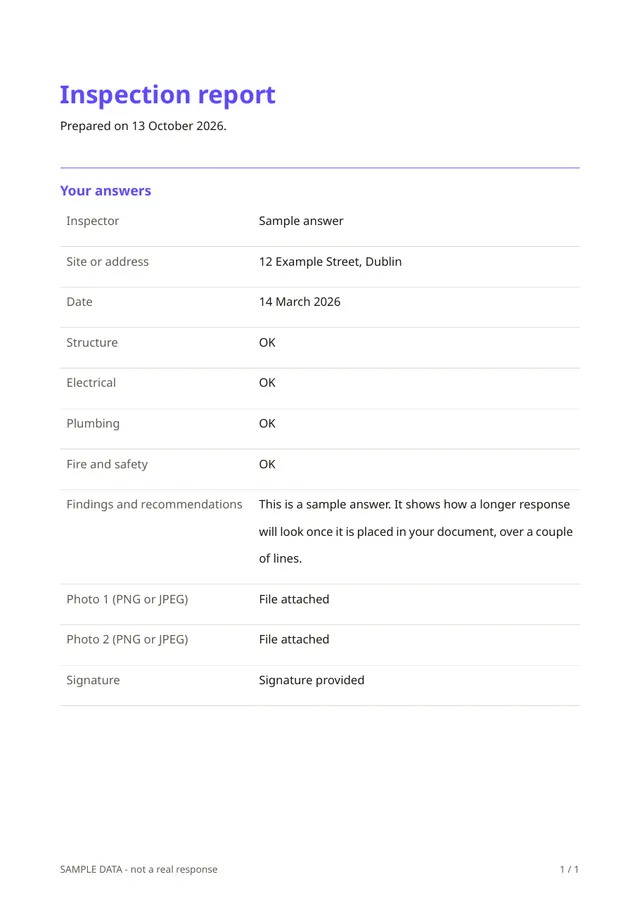
The inspection report template asks for:
- the inspector, the site or address, and the date;
- a rating for structure, electrical, plumbing, and fire and safety, each OK, Needs attention or Critical;
- findings and recommendations;
- two photos;
- a signature.
For a rental property at the end of a tenancy
The move-out inspection checklist asks for:
- the tenant's name, the property address and the inspection date;
- the condition of the living room, kitchen, bathroom and bedrooms, each Good, Normal wear or Damaged;
- damage details;
- two photos and a final meter reading;
- the tenant's signature.
Making it fit your properties
- Add or rename areas. Duplicate a rating question for a garden, a hallway, a second bathroom or a boiler.
- Ask for details only when needed. With a condition, a "What needs attention?" box appears only when an area is not rated OK.
- Take more photos. On a photo question, tick Allow several files to accept up to ten pictures. See question types.
- Record readings with Number questions, and alarm tests with Yes / No.
- Design the PDF once with your logo and business details. See design the PDF.
How it goes on the day
- Open the form link on your phone when you arrive.
- Walk through the property in the order of the form, rating each area and taking photos as you go.
- Write the findings and recommendations before you leave, while you can still check.
- Hand the phone to the tenant or site contact to sign, if they are present.
- Send the form. The PDF can be opened and saved straight away, and a copy of the response and its PDF stays in your account.
Tips for reports people can rely on
- Write what you saw, not what you assume. "Black mould 30 cm wide above the bedroom window" is better than "damp problem".
- Photograph every finding, plus a general view of each room.
- Use the same order every time, so reports can be compared.
- Date and sign every report.
- Send a copy to the tenant or client promptly.
- Follow up the "Critical" items first, and record when they were fixed.
An inspection report is a record of what was seen on the day. It does not replace a professional survey or a safety certificate, and its weight in a dispute depends on the rules where you work. The wording of your form is yours, and so is the responsibility for it.
Start from the inspection report template
Open the inspection report, add the areas you check, your logo and your rating scale, and your next visit can end with a signed PDF. For the end of a tenancy, use the move-out inspection checklist, and for the start, the move-in handover records keys and meter readings.
The template for this
Inspection report
Ready to use: change the questions, add your logo and share the link.
Questions
- How much notice does a landlord give before an inspection?
- GOV.UK's guide for landlords in England says at least 24 hours' notice, although immediate access may be possible in emergencies. In Ireland, Citizens Information says inspections should be arranged in advance, unless there is an emergency.
- Is a property inspection report the same as an inventory?
- No. An inventory lists the contents and their condition at the start of a tenancy. An inspection report records the condition on a given visit. Comparing the two shows what has changed.
- Should the tenant sign the inspection report?
- It helps. A signature shows the tenant saw what was recorded on the day. It does not settle a dispute on its own, so keep dated photos with it.
- Can I add more rooms or more photos to the template?
- Yes. Duplicate a condition question for each extra room, and tick Allow several files on a photo question to accept up to ten pictures.
Related templates
- Move-out inspection checklistRecord the condition of each room when a tenant leaves.
- Move-in handoverKeys, meter readings and first-day notes.
- Maintenance requestTenants report a problem with photos and urgency.
Sources
- GOV.UK: renting out your property, making repairs
- Citizens Information: tenants' rights and responsibilities
Facts checked on 21 October 2026.
All guides
- PDF form builder: how to create a fillable PDF or an online form that produces one
- Job sheet template: what to include, and how to get it signed on site
- Quote form template: the quote you send, and the request form your clients fill in
Send your first document today.
Pick a template, add your logo, share the link. Free during early access.